
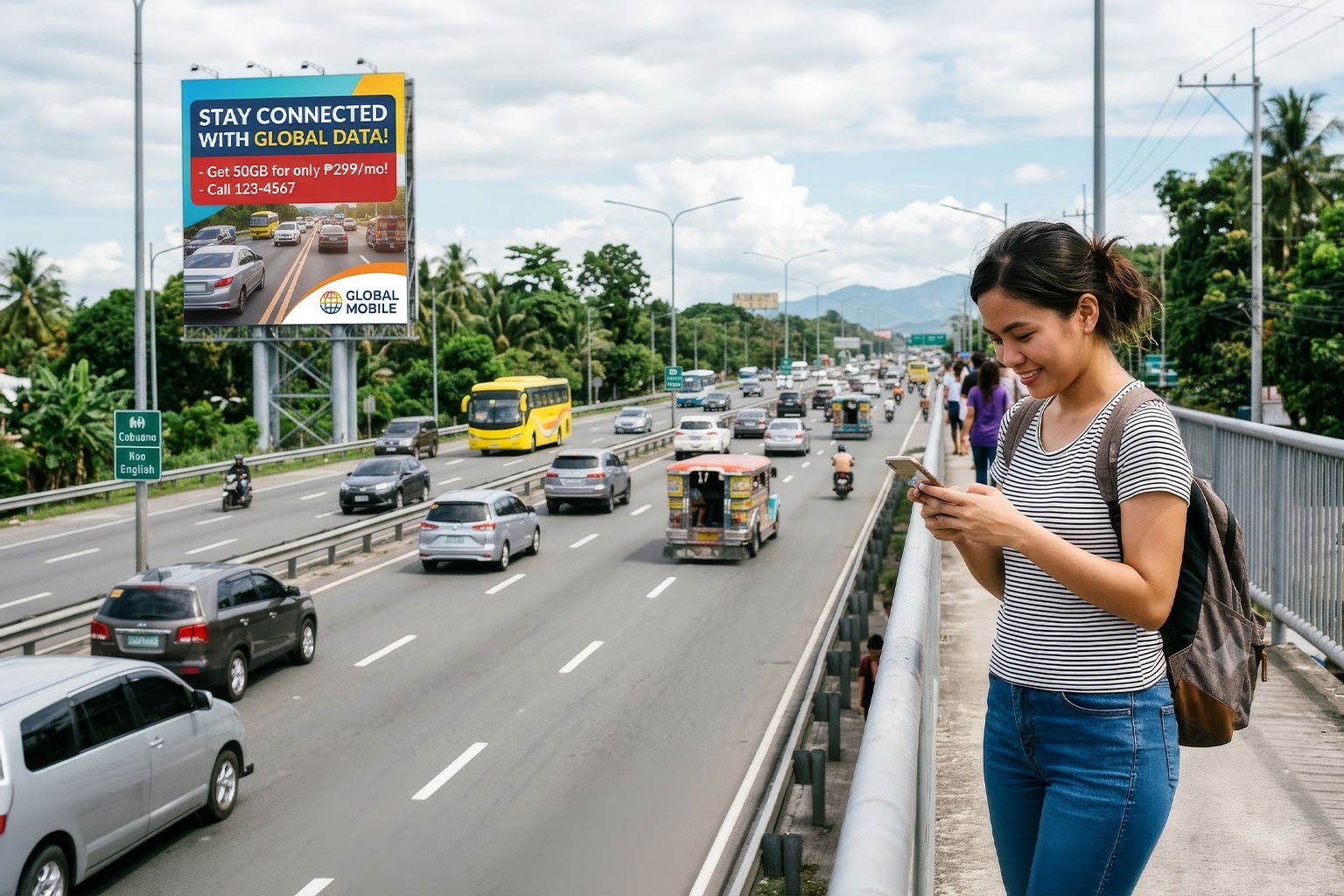
Philippine business owners and marketing managers are often presented with a false choice: billboard advertising or digital advertising. Which one delivers better results? Which offers the best return on investment?
The truth is, this isn’t an either-or decision. The most successful brands in the Philippines today don’t choose between OOH advertising Philippines and digital—they use both strategically, with each channel performing a distinct role in the customer journey.
In this guide, we’ll break down the strengths, weaknesses, and ideal use cases for billboard advertising vs. digital advertising, helping you build an integrated media strategy that maximizes reach, engagement, and conversions for your brand.
1. What Is Billboard Advertising?
Billboard advertising in the Philippines—also known as Out-of-Home (OOH) advertising—refers to any advertising format that reaches consumers while they are outside their homes. This includes:
- Static billboards: Large-format printed panels along highways and major thoroughfares like EDSA, C5, and Commonwealth Avenue
- Digital billboards (DOOH): LED screens displaying rotating or animated ads
- Transit advertising: Ads on buses, jeepneys, trains, and terminals
- Street furniture: Ads on bus shelters, waiting sheds, and park benches
- Building wraps: Large-scale ads on building facades
Billboards exist in the physical world—permanently visible to anyone who passes by. This passive, unavoidable exposure is what makes outdoor advertising uniquely powerful in the Philippine market.
2. What Is Digital Advertising?
Digital advertising encompasses all paid promotional content delivered through internet-connected devices.
Common formats include:
- Search engine ads (Google Ads, SEO)
- Social media advertising (Facebook, Instagram, TikTok, LinkedIn)
- Display/banner ads on websites and apps
- Video ads (YouTube, streaming platforms)
- Email marketing and retargeting campaigns
- Influencer marketing and sponsored content
Digital advertising allows for granular targeting, real-time optimization, and detailed performance tracking—capabilities traditional billboards don’t offer.
3. Billboard Advertising vs. Digital Advertising: Key Differences
| Factor | Billboard / OOH | Digital Advertising |
|---|---|---|
| Reach | Mass, physical visibility | Targeted, based on user data |
| Targeting | Geographic (corridor/city level) | Demographic, behavioral, interest-based |
| Skippability | Cannot be skipped or blocked | Can be skipped, blocked, or ignored |
| Duration | Long-term (weeks to months) | Short-term (days to hours) |
| Cost | Higher upfront investment | Flexible entry budgets |
| Measurability | Impressions, recall surveys | Clicks, conversions, detailed analytics |
| Brand Trust | High—perceived as established | Variable—depends on platform |
| Creative Flexibility | Limited to static or scheduled rotation | Unlimited, real-time changes |
| Geographic Reach | Specific physical locations | Global or hyperlocal |
4. Strengths of Billboard / Out-of-Home Advertising
Why billboard advertising remains essential for Philippine brands:
- Cannot Be Skipped or Blocked: Unlike digital ads that users can scroll past, skip, or block with ad-blockers, billboards are part of the physical environment. They demand attention simply by existing.
- High Brand Trust and Credibility: A brand that appears on a major thoroughfare like EDSA or C5 is perceived as established, credible, and serious. This “trust signal” is especially important for real estate, automotive, pharmaceuticals, and financial services—categories where purchase decisions involve significant commitment and risk.
- Passive, Unavoidable Exposure: Filipinos spend an average of 1-2 hours commuting daily. Billboards capture this captive audience without requiring them to actively browse or search.
- Drives Online Search Activity: Research shows that billboards drive up to 26% more online searches. Consumers who see a billboard are more likely to search for the brand on their phones, bridging the physical and digital worlds.
- Geographic Precision: Billboards allow street-level geographic targeting. A food delivery brand can prioritize dense residential corridors; an automotive brand can focus on highways with high vehicle counts.
5. Strengths of Digital Advertising
Why digital advertising complements billboard campaigns:
- Granular Targeting: Digital platforms allow you to target specific audiences based on age, gender, location, interests, behavior, and even purchase intent. This precision ensures your ad spend reaches the most relevant consumers.
- Real-Time Optimization: Digital campaigns can be adjusted instantly. If an ad isn’t performing, you can change the creative, targeting, or budget within minutes. This flexibility is impossible with static billboards.
- Measurable Results: Unlike billboards, digital advertising provides detailed analytics: impressions, clicks, conversions, cost-per-acquisition, and more. You know exactly what you’re getting for your spend.
- Lower Entry Barriers: Digital campaigns can start with as little as ₱500–₱5,000, making them accessible to small businesses and startups that may not have the budget for premium billboard placements.
- Retargeting Capabilities: Digital ads can “follow” consumers who have already interacted with your brand, increasing conversion rates by targeting warm leads.
6. The Winning Strategy: Integration, Not Competition
The most successful Philippine brands don’t choose between billboard advertising and digital advertising—they use both in a coordinated strategy.
Here’s how integration works:
- Step 1: Build Awareness with Billboards: Use billboards and outdoor advertising to seed brand awareness in the physical world. Get your name, your face, and your message into the environments where Filipinos live and commute.
- Step 2: Capture Demand with Digital: Use digital advertising to capture the demand that brand awareness creates. Retarget people who have already seen your billboard with relevant offers that drive them to act.
- Step 3: Amplify with Social Proof: Combine OOH visibility with social media engagement. A billboard campaign paired with organic and paid social content creates a “surround sound” effect that reinforces your message across multiple touchpoints.
- Step 4: Measure and Optimize: Use digital analytics to measure the impact of your billboard campaign. Monitor branded search volume, website traffic, and direct inquiries during your OOH campaign period.
7. Cost Comparison: Billboard Prices vs. Digital Ad Spend
Understanding the cost dynamics helps you allocate your media budget effectively.
| Advertising Channel | Estimated Monthly Cost | Key Considerations |
|---|---|---|
| Static Billboard (Provincial) | ₱20,000 – ₱80,000 | Long-term brand awareness |
| Static Billboard (Metro Manila) | ₱80,000 – ₱400,000 | Premium exposure, high traffic |
| Digital Billboard (Shared) | ₱30,000 – ₱150,000 | Flexible creative, high impressions |
| Transit Advertising | ₱15,000 – ₱80,000 | Commuter-focused campaigns |
| Street Furniture | ₱8,000 – ₱40,000 | Hyperlocal, budget-friendly |
| Social Media Ads | ₱5,000 – ₱100,000+ | Highly targeted, measurable |
| Google Search Ads | ₱10,000 – ₱200,000+ | Intent-based, conversion-focused |
| Display/Video Ads | ₱15,000 – ₱150,000+ | Visual storytelling, retargeting |
Billboard prices vary by location, format, and duration. Digital ad costs depend on platform, targeting, and competition.
8. Measuring ROI Across Both Channels
How to measure billboard advertising results:
- Impression estimates based on Average Daily Traffic (ADT) data
- Brand recall surveys conducted pre- and post-campaign
- Promo code tracking to directly attribute conversions
- Website traffic spikes during the campaign period
- QR code scans (best for transit and street furniture)
- Sales correlation in the geographic area covered
How to measure digital advertising results:
- Impressions, clicks, and CTR
- Conversion rate and cost-per-acquisition
- Return on ad spend (ROAS)
- Engagement metrics (likes, shares, comments)
- Attribution modeling (which channels drive conversions)
Combined measurement approach:
When running integrated campaigns, use digital analytics to measure the “halo effect” of your billboard campaign. A successful billboard placement should drive:
- Increased branded search volume
- Higher direct website traffic
- More social media mentions and follows
- Improved digital ad performance (higher CTR due to brand familiarity)
Frequently Asked Questions
For small businesses with limited budgets, digital advertising offers a lower entry point and more measurable results. However, affordable options like street furniture and provincial billboard placements can also provide excellent local visibility.
Absolutely. In fact, integrated campaigns consistently outperform single-channel strategies. Use billboards for brand awareness and digital for conversion.
Digital billboards can go live in 24–48 hours. Static billboards require 7–14 days for printing and installation.
Street furniture and provincial static billboard placements can start at ₱8,000–₱20,000 per month. Premium EDSA locations range from ₱80,000 to ₱400,000+.
JMCL specializes in outdoor and broadcast advertising. We can also recommend trusted digital partners to ensure your integrated campaign runs seamlessly.
Why Choose JMCL Media & Marketing
JMCL Media & Marketing is a Philippine-based outdoor and broadcast advertising company specializing in:
- Static billboards
- Digital billboards (DOOH)
- Transit advertising
- Street furniture placements
- TV commercials
With expertise across Metro Manila and nearby provinces, we help brands of all sizes get seen in the right places, at the right time, by the right people. Our team manages all permits, structural compliance, and regulatory coordination—so you can focus on your campaign.
Don’t choose between billboard and digital—dominate with both.
Contact JMCL Media & Marketing today for a free consultation and customized media proposal that integrates the best of both worlds.
Latest Posts