
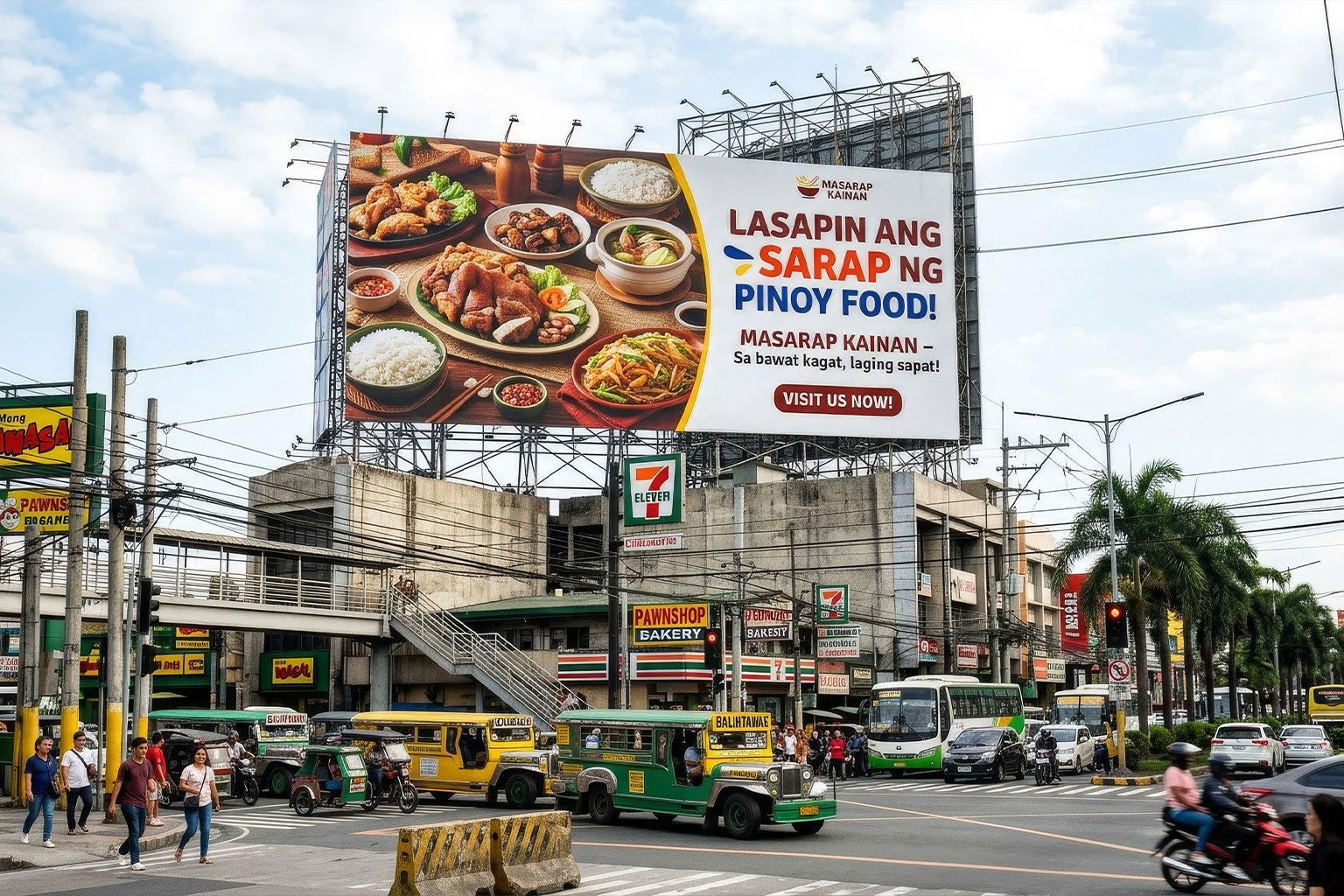
Every day, millions of Filipinos commute along EDSA, C5, and Commonwealth Avenue. They see the same billboards repeatedly. This repetition is the foundation of one of the most powerful advertising tools in the Philippine market.
For business owners and marketing managers, this guide covers everything you need to know about billboard advertising in the Philippines—from formats and locations to permits, pricing, and how to measure success.
1. What is Billboard Advertising?
Billboard advertising, also known as Out-of-Home (OOH) advertising, reaches consumers while they are outside their homes. In the Philippines, this includes the massive print and digital panels along major highways.
Unlike digital ads, billboards cannot be skipped or blocked. This passive exposure is uniquely powerful in the Philippines, where commute times are long. A brand on a major thoroughfare is perceived as established and credible—a vital trust signal for real estate, automotive, and financial brands.
Key Stats:
- 71M+ Filipinos reached monthly via OOH corridors.
- OOH delivers an average 4:1 return on ad spend.
- Billboards generate 3–5x higher brand recall than standard digital display ads.
2. Types of Billboards in the Philippines
| Format | Best For | Key Benefit |
|---|---|---|
| Static/Traditional Billboard | Sustained brand awareness | Cost-effective for long-term campaigns |
| Digital Billboard (DOOH) | Time-sensitive promos | Instant creative updates; higher impressions |
| Transit Advertising | Commuter reach | High visibility on buses, jeepneys, and trains |
| Street Furniture | Hyperlocal targeting | Eye-level placement at bus stops and benches |
| Building Wraps | Maximum impact | Massive visibility for product launches |
| Programmatic DOOH | Data-driven targeting | Run ads only during specific times (e.g., rush hour) |
3. Choosing the Right Location
Location is the most critical factor in OOH success. A billboard on EDSA reaches over 300,000 vehicles daily, while a provincial placement offers better value.
Key Factors:
- Average Daily Traffic (ADT): More traffic equals more impressions.
- Dwell Time: Billboards near stoplights get more focused viewing.
- Visibility: Ensure the billboard is unobstructed by trees or structures.
- Target Audience: Are you targeting BGC professionals or QC residents?
Top Corridors in Metro Manila:
- EDSA: Highest traffic; ideal for mass-market brands.
- C5 Road: Reaches Pasig, Taguig, and Makati; great for tech/auto.
- Commonwealth Ave: High commuter traffic in Quezon City.
- SLEX: Gateway to the south; ideal for real estate and industrial brands.
4. Permits and Regulations
Outdoor advertising in the Philippines is regulated by Local Government Units (LGUs). When you work with an experienced agency like JMCL Media & Marketing, we handle all permits for you.
Standard Permits:
- Billboard Permit (LGU): Annual renewal required.
- Building Permit: For new billboard structures.
- DPWH Clearance: Required for billboards visible from national roads.
- MMDA Clearance: For billboards along EDSA and major thoroughfares.
- CAAP Clearance: For billboards near airports.
5. How Billboard Advertising is Priced
Pricing depends on location, format, and duration. Here is an indicative guide for the Philippine market:
| Format | Estimated Monthly Cost (PHP) |
|---|---|
| Static Billboard (Provincial) | ₱20,000 – ₱80,000 |
| Static Billboard (Metro Manila) | ₱80,000 – ₱400,000 |
| Digital Billboard (Shared) | ₱30,000 – ₱150,000 |
| Transit Ads (Bus/Jeepney) | ₱15,000 – ₱80,000 |
| Street Furniture | ₱8,000 – ₱40,000 |
Prices vary based on location and season. Contact JMCL for a customized quote.
6. Creating an Effective Billboard Ad
You have 2–5 seconds to capture attention. Here is how to make it count:
- One Message, One Visual: Keep it simple. Don’t clutter the design.
- Max 6-7 Words: Drivers can’t read paragraphs.
- High Contrast Colors: Must be readable in sunlight and at night.
- Dominant Logo: Your brand should be unmistakable from a distance.
- Simple CTA: Include a phone number, website, or social handle.
- Filipino Context: Use local imagery that resonates with the audience.
7. Measuring Your Campaign Results
Measuring OOH differs from digital ads. Here is how to track performance:
- Impression Estimates: Based on ADT data provided by your media partner.
- Brand Recall Surveys: Ask your target audience if they saw your ad.
- Promo Codes: Use a billboard-specific code to track direct conversions.
- Website Traffic: Monitor branded search queries during the campaign.
- QR Codes: Best for transit ads where dwell time is longer.
8. Billboard vs. Digital Advertising
The best strategies integrate both channels. They don’t compete; they multiply results.
Why OOH/Billboards:
- Cannot be skipped or blocked.
- Builds trust and credibility.
- Generates passive awareness.
- Drives up to 26% more online searches when paired with digital.
Why Digital Ads:
- Granular targeting.
- Immediate campaign adjustments.
- Easy performance tracking.
The Winning Strategy: Use Billboards to build top-of-mind awareness, then use Digital to convert that attention into leads and sales.
Frequently Asked Questions
Digital billboards can go live in 24-48 hours. Static billboards require 7-14 days for printing and installation.
Street furniture and provincial placements start at ₱8,000 per month.
Yes for digital. For static, changing the creative requires reprinting and reinstallation (additional costs).
Yes. JMCL Media & Marketing manages all permits, structural compliance, and regulatory coordination on your behalf.
JMCL Media & Marketing is a Philippine-based outdoor and broadcast advertising company specializing in static billboards, digital billboards, transit advertising, and TV commercials across Metro Manila and nearby provinces. We help brands of all sizes secure prime locations that deliver maximum ROI.
Ready to elevate your brand? Contact JMCL Media & Marketing today for a free consultation and customized media proposal.
Latest Posts